Northern Sri Lanka
 |
| Hindu temple |
Jaffna
After two days of travel, we arrived in Jaffna, the northern most city
at the tippy top of the island. Jaffna is the economic and cultural
center of the north with a predominantly Tamil population, who are
mostly Hindu, making this a very different culture than the south, that
is Sinhalese and mostly Buddhist.
 |
| Entertainment at your seat on the train for only a small donation |
 |
| Eating rice and curry Jaffna style off a banana leaf, McDonald's, take a lesson! |
 |
| Jaffna public library after renovation |
 |
| Margaret on the 1680 Dutch fort wall constructed out of coral |
The highlight of our Jaffna visit were the Hindu temples festooned with
color and statues. The largest and most elaborate temple, Nallur
Kandaswamy, is Jaffna's claim to fame. It is a huge temple with a
gopuram that towers like a huge multi-layered wedding cake with hundreds
of brightly colored statues of gods reaching high up into the sky.
Inside the temple a wide, wide corridor circles around a square pool
that is open to the sky. The colorful terrazzo floor of the corridor
pales next to the scores of beautifully painted geometric arches that
each repeat their patterns with new color combos and entice you onto
the many shrines of the blue, green and yellow-skinned gods. Oil lamps burn and
shirtless men worship at each shrine while women dressed in white drop
coins in the wooden offering boxes.
 |
| Nallur Hindu temple entrance (photos where not allowed inside) |
 |
| 30 foot Monkey God |
 |
| All dressed up for the temple |
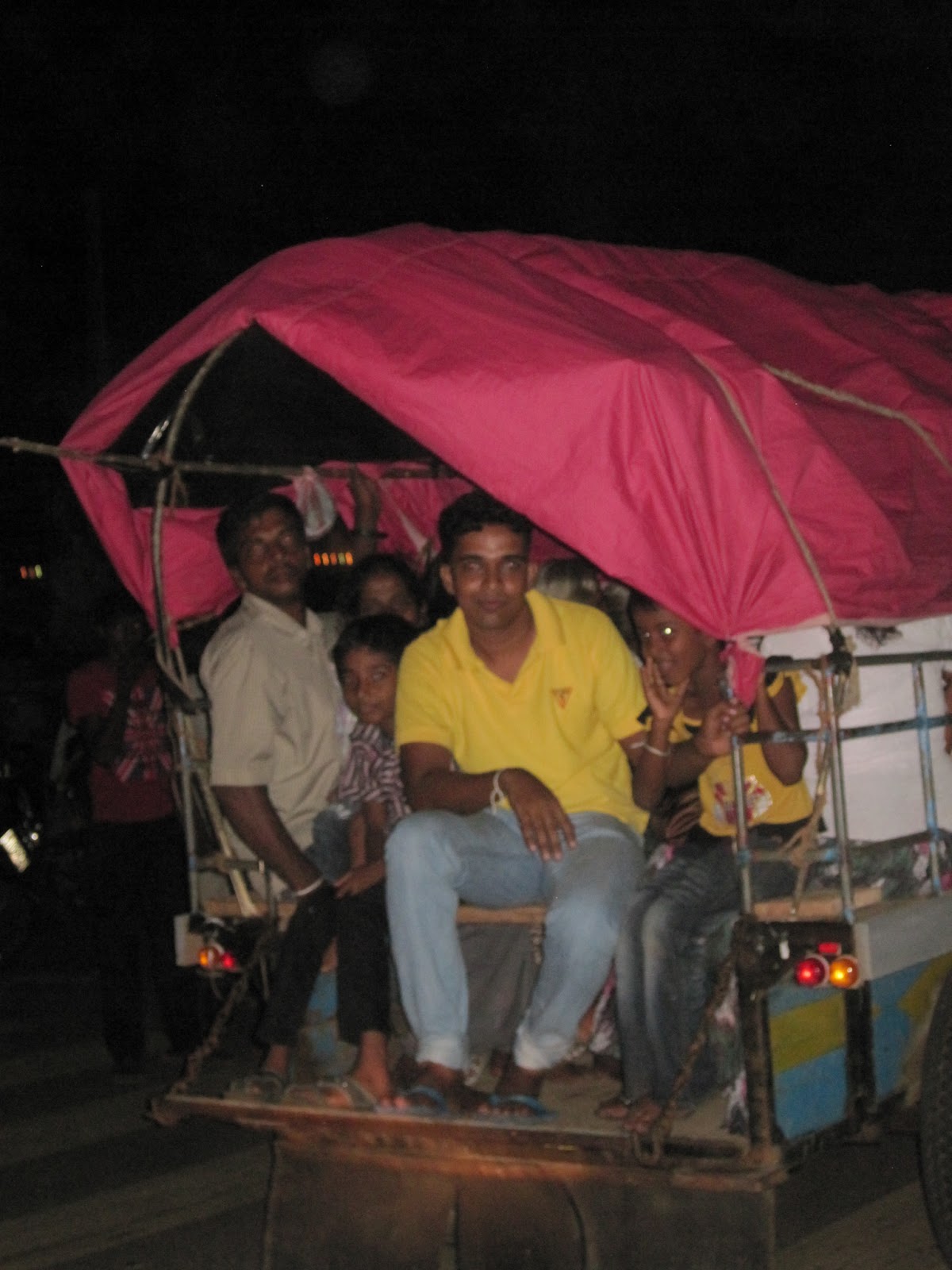
In order to reach another temple on a small island off the tip of a series of island off the peninsula we drove on a very long causeway and took a rather old fishing boat to the island. It was a Sunday and the boat was filled with worshipers all dressed up for the temple.
 |
| Our ferry boat to the temple |
 |
| Repairing their fishing boat and staying cool |
 |
| On their way to temple |
When we arrived, a Puja was in progress, which is a ceremony that has four men carrying a throne with a Hindu god statue. The procession was accompanied by a drummer, priest and a woman with a bowl of fire on her head. As they proceeded around the temple, the faithful followed carrying fruit and flower offerings. Very dramatic and colorful.
 |
| A sacred cow hanging out in front of the temple with the faithful |
 |
| A pregnant woman holding up a god, women here do all the work |
 |
| Refreshment stand for worshipers on the way to temple |
The northern part of Sri Lanka is where the war was fought, and there is
still a lot of evidence of war, including red skull and cross bone signs
along the road where they are still deactivating the land mines. In
those areas you can not leave the road. The war ended in 2009 and there
has been a lot of reconstruction of roads and homes, but still you can
see bombed buildings and houses full of bullet holes. I feel so sorry
for the people who were caught in the war.
 |
| Warning sign for landmines not yet deactivated |
 |
| A ship captured by the LTTE and used for selvaged metal for barricades |
After visiting six schools, we realized the children are way behind
because of the war. Only 15% passed English on their 10th grade exams.
 |
| American English Access class and their teachers |
 |
| American English Access class in Mullaitivu of 14 and 15 year old kids |
We did two day workshops for the English teachers and they begged us to come
back because they have little to no training and are struggling
themselves with English. Sometimes it is hard to stay positive when the
need is so great. One town we visited just got power after not having
electricity for the 30 years of the war. Other villages still do not
have electricity.
 |
| Jenise working with English teachers |
None-the-less the children are resilient and are so excited to talk to
us when we visit. The most common questions are "How old are you?" and
"Where are you from?" It really is fun to have celebrity status in
those villages where we are swarmed by the children and adults alike.
 |
| Lots of smiles |
Mullaitivue
This area was the hardest hit by the war. The main road, after four
years, is almost reconstructed, but all the other roads are full of
potholes big enough to loose your cow in, making travel very slow going.
 |
| Abi and Lithu off to school |
 |
| Making hoppers, noodles that are steamed in tiny stacked baskets in a covered pot over a wood fire |
We had the good fortune to stay with one of the teachers and meet her
extended family. Mary and her mother-in-law cooked us many traditional
dishes including coconut pancakes, hand-made rice noodles, and pitu, a
rice flour and coconut dish. It was great to watch them prepare all
the food and cook over the wood fire.
 |
| Mary and her husband with his delivery truck full of bananas |
 |
| Grandma making pitu, rice floor and coconut cut into a fine meal and browned in a hot pan |
Kilinochchi
Our last stop before heading back home was Kilinochchi. We stayed in one
of the few guest houses and had our meals in the attached restaurant.
What we noticed about this area is there are few cars and many more
bicycles that carry everything, including entire families and six foot
high stacks of wood.
The schools are all open air with no windows or doors, to allow the
breeze to blow through if there is one. Schools have only the basics,
small very used desks and chairs and blackboards and no other media
equipment or even pictures on the walls.
 |
| Typical Sri Lanka classroom |